
India's unemployment rate for individuals aged 15 and older increased to 5.1 per cent in March 2026, up from 4.9 per cent in February, primarily due to a rise in joblessness in urban areas, according to government data.

The Enforcement Directorate (ED) has attached fresh properties worth over Rs 5,000 crore as part of its money laundering investigation against Chandigarh-based PACL (Pearls Group), accused of orchestrating a Rs 48,000 crore ponzi scheme.

Indian markets on Dalal Street rallied sharply as easing tensions in the US-Iran conflict and stable oil prices boosted sentiment. Track Nifty 50 and BSE Sensex performance and key global triggers.

The Indian rupee fell to a record low against the US dollar due to rising crude oil prices, foreign institutional investor selling, and weak domestic equity market sentiment.
Indian benchmark stock indices Sensex and Nifty rebounded, closing over 1% higher, mirroring a global equities recovery after recent losses due to geopolitical tensions.

Indian benchmark stock indices Sensex and Nifty rallied for the second consecutive day, closing nearly 1 per cent higher, driven by gains in metal and auto sectors and positive global market trends.

Financial year 2025-26 (FY26) saw a significant shift in corporate fundraising, with rights issues more than doubling to a multi-decade high of 51, raising 44,290 crore, while qualified institutional placements (QIPs) more than halved to 29 issues, mobilising 62,954 crore, driven by sharp equity market corrections and regulatory changes.

The Telangana government's salary structure reveals surprising figures, with senior sweepers earning up to 2 lakh and chief engineers drawing 7 lakh monthly.

India's net oil import bill could rise by $56 billion to $64 billion annually assuming global crude averages $110 to $115 per barrel in FY27.

Analysts are increasingly optimistic about India's capital markets, with HDFC AMC, CAMS, and KFin Technologies identified as top investment picks. This optimism stems from a structural shift in household savings towards financial instruments and an expected multi-year earnings expansion for market infrastructure providers and asset management companies.

India's unemployment rate saw a marginal decrease in February 2026, according to the Periodic Labour Force Survey (PLFS). The survey highlights changes in urban and rural unemployment rates, as well as labour force participation and worker population ratios.

A Deloitte report reveals that Indian enterprises are leading the world in large-scale AI adoption, but are facing a significant skills gap in AI expertise.
The Indian rupee crashed to a record closing low against the US dollar due to rising global crude oil prices, a strengthening dollar, and geopolitical tensions in the Middle East.

Uncertainty stemming from the US-Iran conflict has significantly impacted India's mutual fund industry, leading to a sharp decline in new fund offers (NFOs) in March, despite numerous regulatory approvals. This geopolitical tension, coupled with existing market strain and distributor hesitation, has dampened investor sentiment and affected overall inflows.
A Lenovo study reveals that Indian enterprises are planning to increase their investments in Artificial Intelligence (AI) at a higher rate than other countries in the Asia-Pacific region.

Retail inflation stood at 2.75 per cent in January under the new series of All India Consumer Price Index (CPI), with 2024 as the base year, released on Thursday.

Rashid Naseem, wanted in India for an alleged investment fraud, has been arrested in Dubai following an Interpol Red Notice and extradition request.
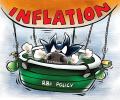
The Indian government has extended the Reserve Bank of India's (RBI) mandate to maintain retail inflation at 4 per cent, with a tolerance band of 2 per cent on either side, for another five years until March 2031.

Indian banks are urging the Reserve Bank of India (RBI) to reconsider its new $100 million cap on net open foreign-exchange positions, warning that the directive could lead to significant mark-to-market (MTM) losses and force an accelerated unwinding of trades, potentially impacting FY26 earnings.

The Indian rupee weakened against the US dollar due to rising crude oil prices, geopolitical tensions in the Middle East, and foreign fund outflows.

'Multi-asset funds have cornered 30 per cent of hybrid fund inflows in 2025, reflecting a growing preference for diversified portfolios that combine equity, debt and commodities.'

India is the second-most-preferred destination among chief executive officers planning international investments - up from the fifth spot last year, according to PwC's 29th Annual Global CEO Survey released on Tuesday. The United States is their first choice.

The new labour Codes, notified by the central government in November 2025, have pushed up employee costs for private-sector banks and insurance companies, with these firms reporting higher operating expenses in the October-December quarter (Q3FY26) due to the statutory impact of the new labour Codes.

The life insurance industry recorded nearly 40 per cent year-on-year (Y-o-Y) growth in new business premiums (NBP), aided by the rationalisation of goods and services tax (GST) on individual life insurance premiums, which has made policies more affordable for consumers.

Private sector banks slipped in market capitalisation (mcap) during the July-September quarter, underperforming their government-owned peers as trade uncertainties dragged market sentiment, said S&P Global Market Intelligence. According to its analysis, HDFC Bank shed 4.8 per cent in mcap during the third quarter, while ICICI Bank's dropped 6.7 per cent.

India's state-level fiscal rules have improved headline deficits, but the gains are fragile and uneven with major states still grappling with high debt levels, a World Bank report submitted to the 16th Finance Commission (FC) said. According to the report, despite nearly two decades of adoption of fiscal responsibility laws (FRLs), debt levels have not converged.

Trading pattern in the stock market this week will largely depend on the ongoing Q3 earnings announcement from corporates, global trends, and foreign fund movement, analysts said. Moreover, geopolitical developments and any update on trade negotiations would also be keenly tracked by investors, experts noted.

India's main inflation measure, the Consumer Price Index (CPI), is set for another major update, even though it has been in its current form for only about 15 years.

Macroeconomic data announcements, global trends and trading activity of foreign investors would be major driving factors for market movement this week, analysts said. Unabated capital infusion by domestic institutional investors have supported the positive trend in the stock market last week, traders said.

From the Sensex pack, Eternal, Maruti Suzuki India, Kotak Mahindra Bank, Mahindra & Mahindra, Tech Mahindra, Titan, HDFC Bank, PowerGrid, Bajaj Finserv, HCL Technologies, Bajaj Finance and Larsen & Toubro were among the gainers. On the other hand, Tata Motors Passenger Vehicles, Asian Paints, UltraTech Cement, Bharat Electronics Ltd, Tata Steel, Adani Ports, Hindustan Unilever, ITC, Tata Consultancy Services and Reliance Industries were the only laggards.

From the Sensex pack, Eternal, Bharat Electronics Ltd, Trent, Axis Bank, State Bank of India, Bajaj Finance, Sun Pharmaceuticals, Asian Paints, Adani Ports, Hindustan Unilever, Reliance Industries, ITC, PowerGrid, Tata Motors Ltd's Commercial Vehicles business, and Bajaj Finserv were the gainers. Infosys, Tata Motors Passenger Vehicles, Tata Steel, ICICI Bank, Tech Mahindra, Titan, UltraTech Cement, Maruti Suzuki India, and Larsen & Toubro were the laggards.

A neutral monetary policy stance, heavy government borrowing, and issuers adjusting to a higher-for-longer yield environment have set the stage for a largely stable corporate bond market in 2026.

The government should refrain from raising income tax surcharge on the super-rich and reintroducing wealth tax in the upcoming 2026-27 Budget, as the move could prompt persons in high-income brackets to leave the country for low-tax jurisdictions, according to tax experts.

The Centre is considering amendments to the Recovery of Debt and Bankruptcy Act in the Budget to allow some Debt Recovery Tribunals to focus only on high-value cases.
The committee formed under the Life Insurance Council to review the commission structure in the life insurance sector has recommended capping distributor commissions or deferring them to ease acquisition costs. The recommendations will be sent to the insurance regulator -- Insurance Regulatory and Development Authority of India (Irdai).

The European Union's (EU's) offer to slash tariffs on 97.5 per cent of Indian chemical exports to zero is set to give India's pharmaceutical and medical device firms preferential access to the European markets.

Foreign investors have pulled out Rs 11,820 crore ($1.3 billion) from Indian equities in the first week of this month, primarily driven by the sharp depreciation of the rupee. This sharp withdrawal follows a net outflow of Rs 3,765 crore in November, further pressuring markets.
The loss of input tax credit (ITC) following the rationalisation of the goods and services tax (GST) on individual life and health insurance from 18 per cent to nil is may weigh on the profits of life insurers in the third quarter (Q3) of 2025-26 (FY26).
Retail inflation rose to a three-month high of 1.33 per cent in December 2025 mainly due to higher prices of kitchen essentials, including vegetables and protein-rich items.
Banks are depending more heavily on the market for certificates of deposit (CDs), whose worth climbed to a record Rs 5.75 trillion in the fortnight to January 15, owing to deposit tightness in the system.
